
Am I in the Right Workplace?
You draft a message to work saying that you need a day off. You read it several times, then delete it… You are frightened that one absence will become part of the story people tell about your reliability.
The next morning, you arrive on time. You appear calm, friendly and professional. When you return home, you have no energy to speak, cook or make another decision. Work did not just require you to do your job… It required you to hide what doing the job was costing you.
You may think you have lost capacity. But perhaps some of it is being used to keep what you are carrying from showing.
You may not connect these moments with what you are holding or with how much energy it takes to keep it contained. You may simply decide that you need to try harder.
Professional identity: When struggling starts to feel like failing
The effects of trauma do not stay neatly outside working hours. They can affect concentration, memory, confidence and how much pressure you can manage.
For instance, feedback may flood your body before your mind has understood what is being said.
A neutral email asking, “Can we talk later?” may take over the rest of your day…
In a meeting, you have something useful to contribute. But while waiting for a gap, you become aware of your breathing, your voice and the expression on your face. By the time you have worked out how to speak without sounding nervous, the moment has passed. Later, you tell yourself to be more confident next time.
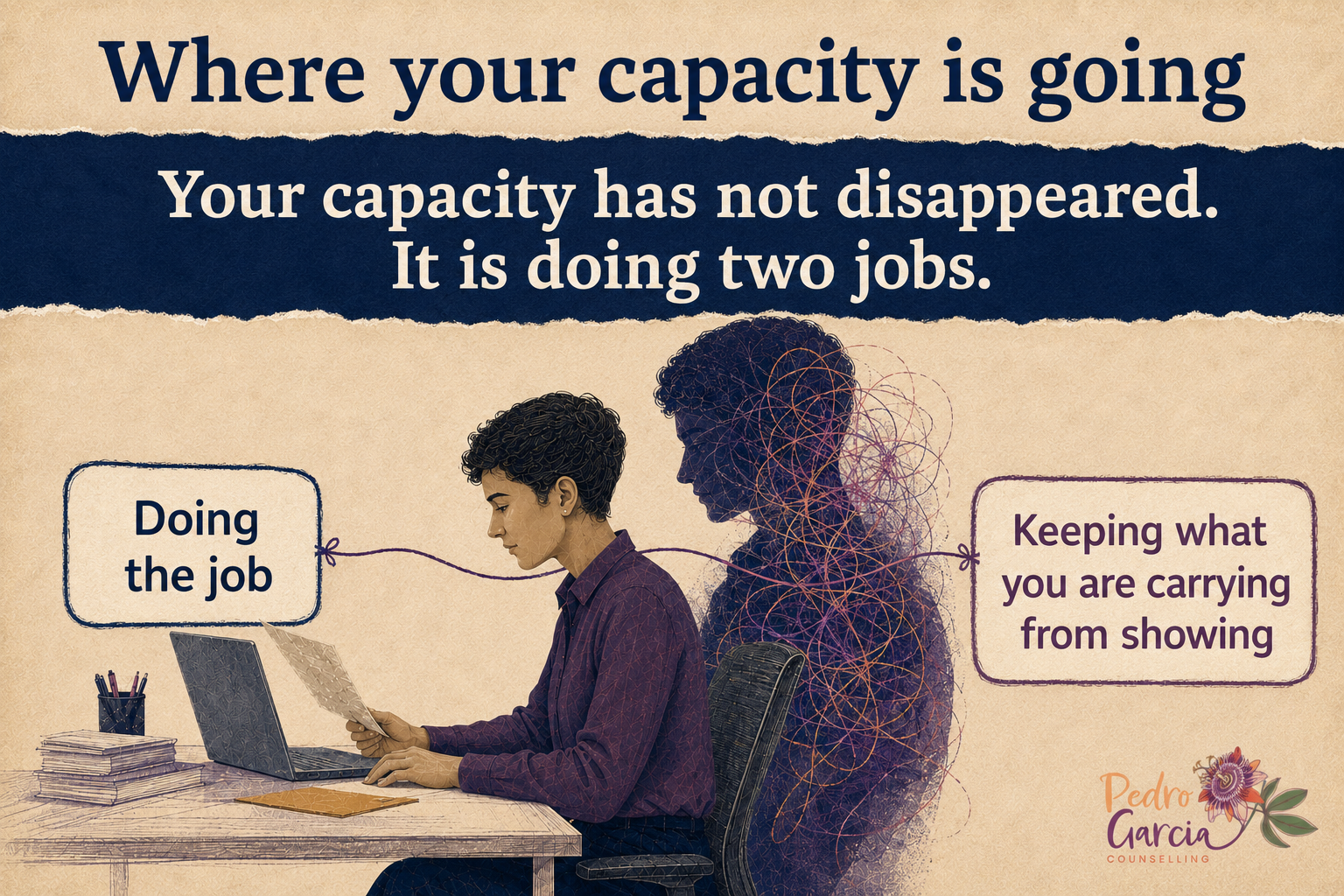
Where your capacity is going
Trauma affects people differently. But when your capacity changes without a clear explanation, it is easy to turn that change into a judgment about who you are.
So you compensate….
You overprepare…
You stay late or remain available when you need rest….
You avoid questions because you do not want anybody to notice that information is not staying with you…
From the outside, this may look like commitment. Inside, it can feel like a daily attempt to protect your professional identity.
That identity matters. In a world where people are expected to appear productive, confident and ready for more, being seen as capable is not only about pride. It may be connected to your income, independence and future. Work may also be where you still recognise yourself when other parts of life feel unstable.
This is why asking for support can feel so risky…
The fear is not only, “Can I still do this job?” It is also, “What will people believe about me if they see that I am struggling?”
You may need your working conditions to change without wanting your professional identity to change with them.
Emotional Dignity at Work.
Support should make work more manageable. It should not make the person feel smaller.
This is what I mean by Emotional Dignity at Work: being able to have a difficult time without becoming “the difficult employee.”
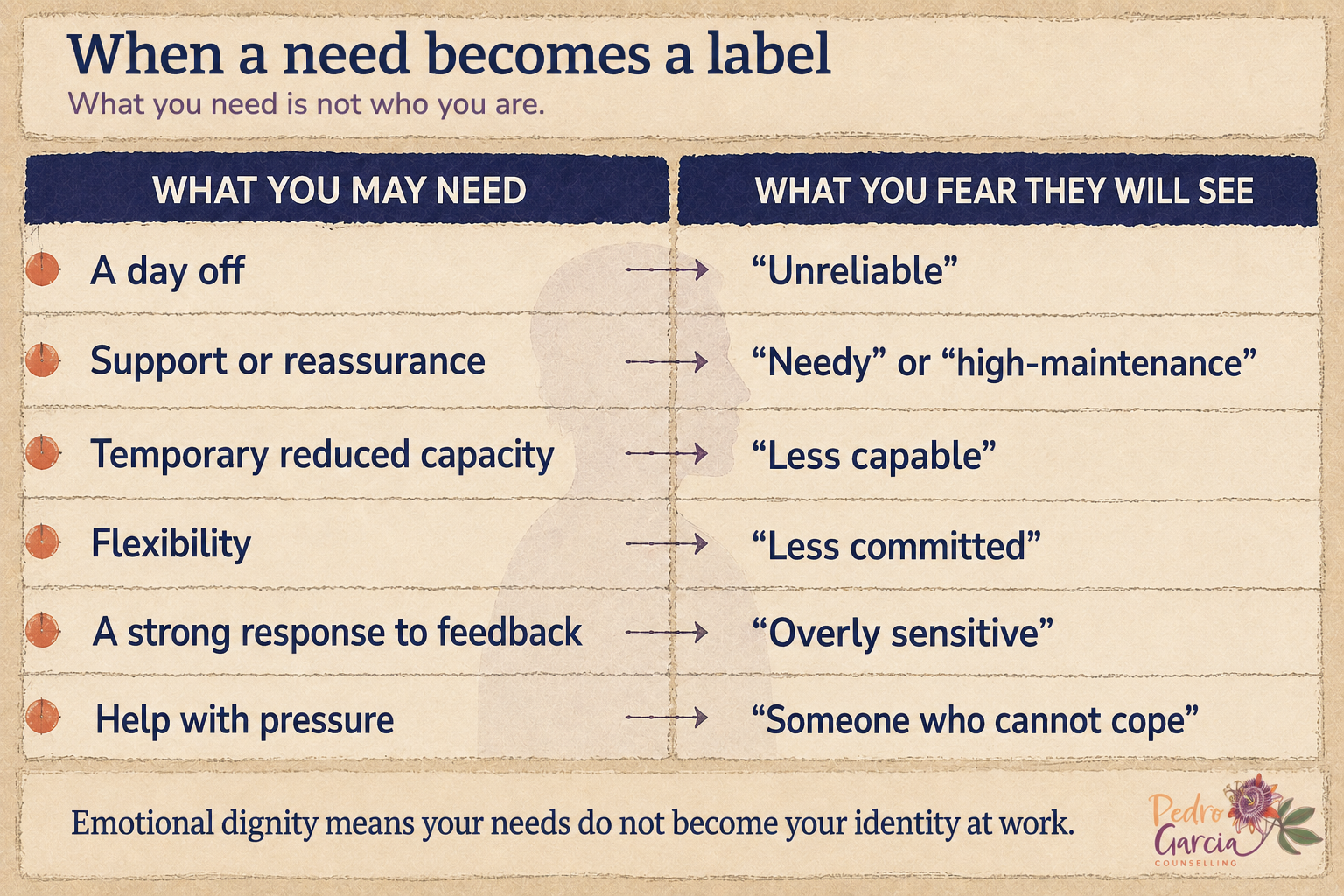
When a need becomes a label
You can be struggling and still be capable. Thoughtful and contained support should be able to hold both truths.
It means receiving support while keeping your privacy, ambition and voice. You remain part of decisions about your work rather than having those decisions made for you.
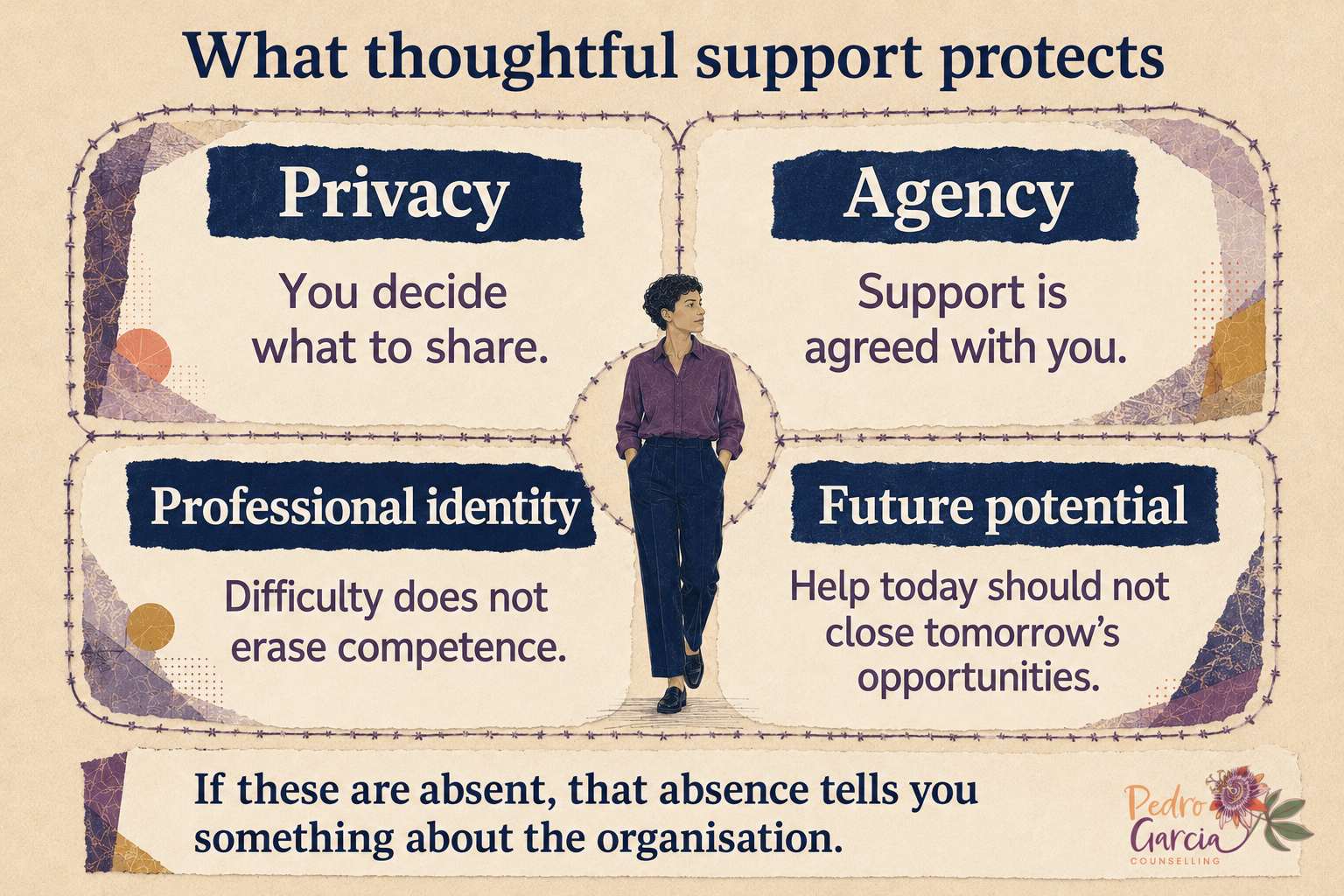
What support should never cost you
You should not have to choose between having your difficulty recognised and continuing to be respected as capable and professionally valuable.
Good support should protect more than your ability to get through this week. It should protect your agency and future.
Your capacity today is not the complete measure of your future potential and support should not come at the cost of your voice, opportunities or professional identity.
Yet some workplace responses can look caring while quietly leaving you with less. One begins making decisions for you. Another leaves you dependent on who happens to respond.
These are the Sympathy Downgrade and the Kindness Lottery.
The Sympathy Downgrade: when kindness starts deciding for you
Imagine telling your manager that you are going through something difficult... You do not give every detail. They respond warmly, and you feel relieved.
A few weeks later, you discover that somebody else has been asked to present a piece of work you led. You are no longer included in an important project. When you ask why, your manager says:
“I didn’t want to put any more pressure on you.”
This sounds caring. But nobody asked what you wanted or what kind of pressure had become difficult. Support was offered by removing an opportunity.
This is the Sympathy Downgrade: someone receives kindness after disclosing, but quietly loses trust, responsibility or opportunity.
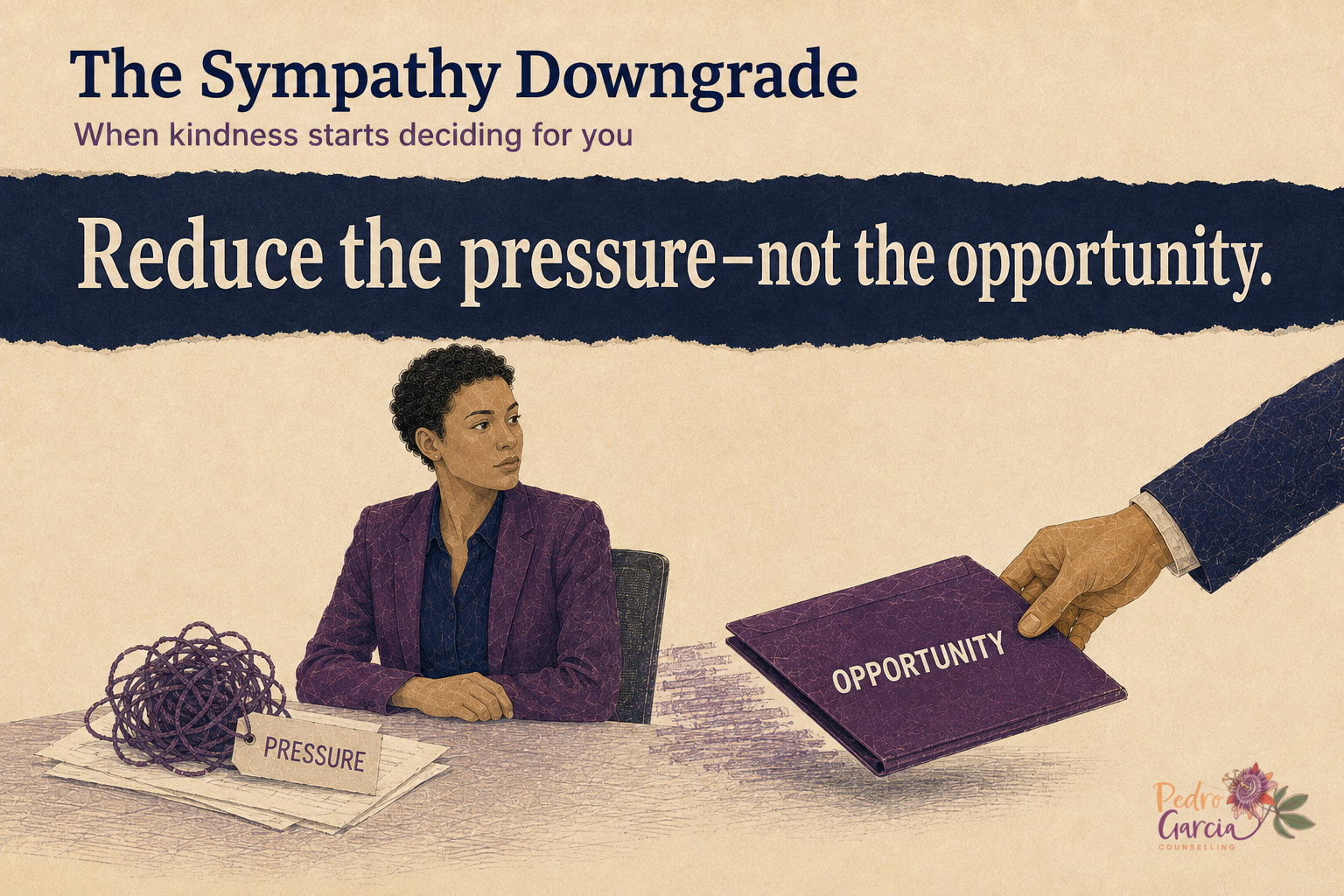
The sympathy downgrade
Kindness is not the problem. The problem begins when sympathy replaces respect and conversation. You may be treated more gently while being taken less seriously.
This is kindness without agency: someone decides what you can manage without asking you. You wanted help with the pressure. You did not want to disappear from professional life.
Thoughtful support asks what needs to change and what the person wants to keep. It does not remove responsibility or opportunity “for your own good” without including you.
The Kindness Lottery: when support depends on who you get
Now imagine that your manager informally lets you work from home after difficult nights. It helps enormously. You are grateful, but nothing is written down.
Each time, you wonder whether you can ask again:
Do colleagues resent it…?
Do you now owe your manager something…?
Could it later be used as evidence that you are less committed…?
…
Then your manager goes on leave. Somebody else takes over and applies the rules differently. The support disappears just when you have started to rely on it.
This is the Kindness Lottery: your experience depends on whether the manager you happen to have is unusually understanding, confident or personally familiar with trauma.
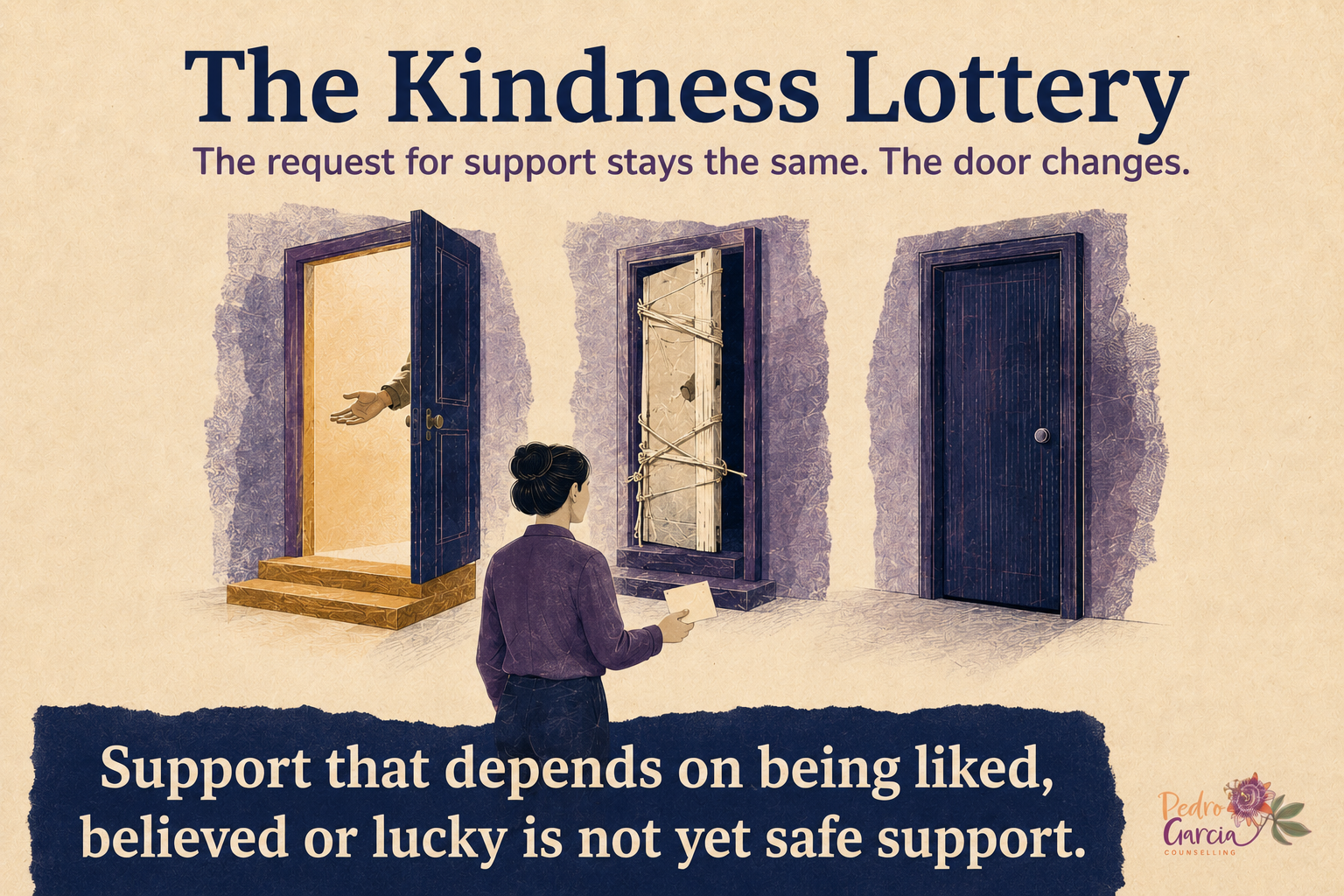
The kindness lottery
Individual kindness can make a difficult week more bearable. It cannot replace a dependable system.
Thoughtful support should be clear, consistent when personnel change and flexible enough to respond to the actual person. It should be reviewed, so your current needs do not become a fixed story about your capability.
This is what thoughtful support looks like. This is what it should protect. And if it is absent, that absence tells you something about the organisation.
So, are you in the right workplace?
The answer may not be immediate. Leaving is not always simple or possible. Finances, immigration status, family responsibilities and available opportunities can limit your choices.
But the question can still change where you place the blame.
Instead of asking only, “Why am I struggling?”, you might also ask, “What does this workplace’s response tell me about the organisation?”
Can it support you without making you feel smaller?
Can it respond before you reach a breaking point?
Can you ask for something different without surrendering your privacy, professional identity or future?
Does its support belong to the organisation, or to one unusually kind person?
These questions sit at the heart of Invisible Trauma, a project Michelle Charlesworth and I are developing to help organisations prepare leaders for these moments before an employee reaches breaking point. The aim is not to turn managers into therapists. It is to help workplaces respond with clarity, consistency and respect when something difficult enters working life.
The right workplace is not one where you never struggle. It is one where struggling does not cost you your dignity.
What does the response tell you about the workplace?
In England, Scotland and Wales, trauma does not automatically create a legal right to reasonable adjustments. Under the Equality Act 2010, a physical or mental impairment may be a disability when it has a substantial and long-term effect on normal daily activities. When this applies, an employer must consider reasonable adjustments. What is reasonable depends on the person, role and employer.
Even when the legal threshold is not met, Acas advises employers to explore helpful changes. A workplace need not wait until somebody is seriously unwell before responding thoughtfully.
Containing difficulty, overworking and remaining constantly available can use enormous energy. When chronic workplace stress is added and recovery keeps being postponed, serious exhaustion (and sometimes occupational burnout)may follow. The World Health Organization defines burnout specifically in relation to chronic workplace stress that has not been successfully managed.
A trauma-aware workplace knows that trauma exists. A trauma-informed workplace understands that it may affect how people experience communication, pressure, uncertainty and power. A trauma-responsive workplace allows that understanding to change what it actually does. This reflects the UK Government’s working definition of trauma-informed practice, which draws on SAMHSA’s framework: understanding trauma should change policies, procedures and everyday practice.
In real terms, this means curiosity before judgment, explaining privacy, agreeing support before crisis and continuing to see the person’s value and future.

Has this article resonated with you?
I’m Pedro, a BACP-registered counsellor offering therapy in English and Spanish, online and in person in London Bridge and Greenwich. My work is trauma-informed, neurodivergence-aware and LGBTQIA+ affirming.
Counselling can offer a space to explore what you have been carrying without having to defend or fully explain it first. We can look at why work has begun to feel so exposing, what it takes to appear fine, and how trauma, shame, masking, identity or earlier experiences may be affecting your capacity and sense of yourself.
Would you like to know a little more about me and how I work?
Choosing a counsellor can feel personal. You may want to understand more about my approach, the values that shape my work, and what you could expect from therapy with me before deciding whether to get in touch.